Web performance · Core Web Vitals · WordPress
PI Startup Website Speed Optimization: PageSpeed 100 / 99
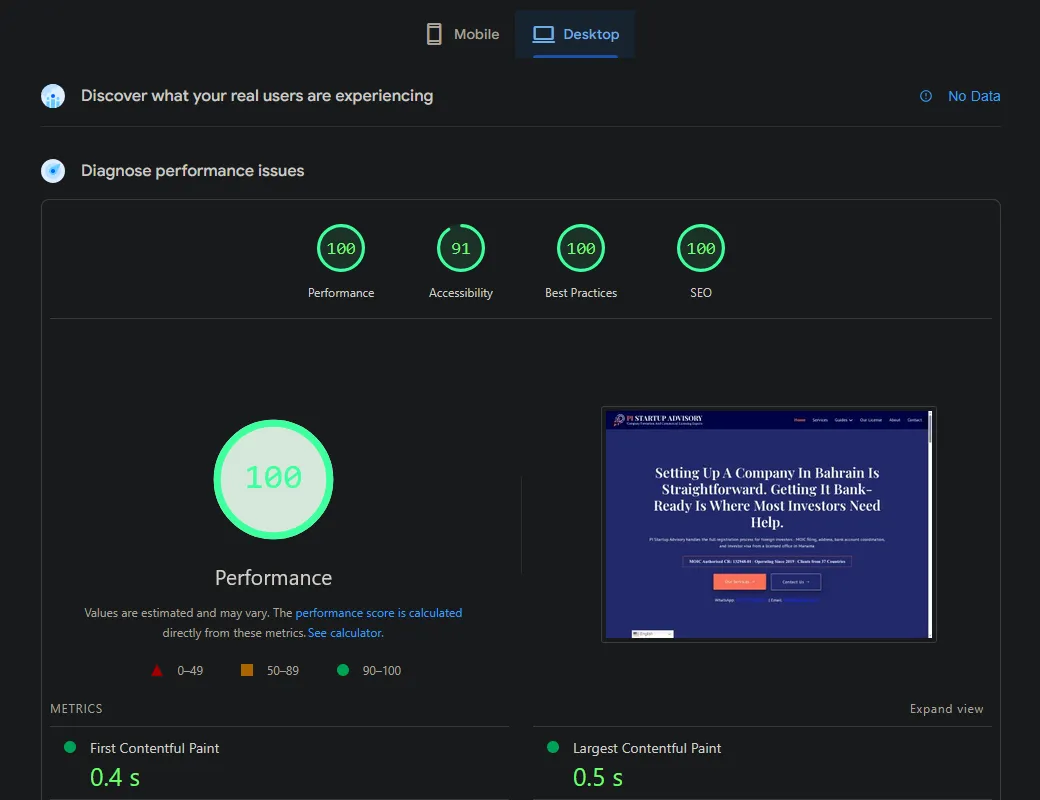
A heavy 100+ page Divi estate rebuilt around a performance budget, reaching PageSpeed 100 desktop / 99 mobile with GTmetrix at 100% and Pingdom at 99.
Results at a glance
- PageSpeed
- 100 / 99
- GTmetrix
- 100% · 491ms
- Pingdom
- 99 · 900ms
Desktop / mobile
Performance grade A
Independent check
The problem
The PI Startup build had grown into a 100+ page Divi estate with heavy section usage, large images and a long list of third-party scripts. Desktop performance was acceptable in places, but mobile was the constraint. The site was asking phones to download and execute more than the layout needed.
That mattered beyond a lab score. The site is a lead-generation property: slow pages create friction before a visitor ever reaches a form. Core Web Vitals also sat inside the same technical programme as crawl and indexation work, so speed could not be treated as a separate cosmetic task.
Why we decided to solve it
We were already planning the Divi to Bricks migration. The risk was rebuilding the same weight in a new builder and calling it done.
Instead, we set a speed budget before the redesign: define what the page is allowed to load, then design inside that budget. That meant fixing the delivery layer first so the design team could see the real cost of each choice.
The target was not a one-off PageSpeed screenshot. It was a production build that could hold its scores after new sections, tracking scripts and market-specific content were added.
How we did it
Move delivery closer to the visitor
Cloudflare was configured in front of Hostinger Cloud, with caching rules for static assets, HTML and the WordPress install. That reduced the distance between the server and the people the site was actually serving.
Fix the image pipeline
Images were the largest single source of weight. We introduced Optimole and ShortPixel delivery, moved the build to WebP, controlled dimensions at source and removed images that were being loaded at sizes the layout never displayed.
Treat fonts and scripts as a budget
Font loading was limited to the weights and styles in use. Third-party scripts were audited and deferred or removed where they did not earn their cost. The remaining scripts were loaded with the page rather than blocking it.
Measure on every release
PageSpeed Insights, GTmetrix and Pingdom were used together because each exposes a different part of the problem. Scores were checked against the live production URL after caching, CDN and image settings were active — not against a local build.
The result
The production site reached PageSpeed 100 desktop / 99 mobile. GTmetrix reported 100% performance, A grade and 491ms, while Pingdom recorded 99, A grade and 900ms on the same release.
More importantly, the speed budget became part of the rebuild. The Bricks migration inherited an image pipeline, a CDN configuration and a script policy instead of a finished score that would drift on the next campaign page.
The same method was later applied to two personal sites on budget shared hosting, where the gains were much larger relative to the starting point.
Evidence
What the work looked like.
Captures from the engagement. Images marked as redacted have sensitive business data blurred before publication.
Contact
Want to talk through a project like this?
I am open to remote SEO, web design and performance roles. If you need more detail on a specific project, ask — I will share what the client allows.
- fassihfayyaz@gmail.com
- Phone
- +92 322 6189669
- Location
- Multan, Pakistan · Remote
- Status
- Open to remote roles